







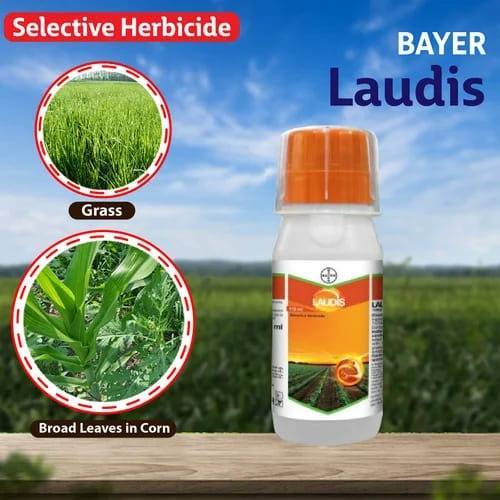
Product Description: Laudis Herbicide
What is Laudis
-
Laudis is a selective, post-emergence herbicide developed by Bayer CropScience.
-
It is used for weed control in maize / corn (field corn, sweet corn, seed corn) crops.
Active Ingredient & Formulation
-
Active Ingredient: Tembotrione (a triketone herbicide), typically formulated as 42% SC (34.4% w/w) in many markets.
-
There is also a formulation with a safener (Isoxadifen-ethyl) in some versions for improved crop safety.
Mode of Action
-
Laudis inhibits the enzyme 4-hydroxyphenylpyruvate dioxygenase (HPPD) in weeds.
-
HPPD inhibition disrupts the formation of carotenoids (pigments that protect chlorophyll). Without carotenoids, chlorophyll gets damaged by light (photobleaching), which impairs photosynthesis and kills the weed.
Spectrum of Weeds Controlled
-
Works on both broadleaf weeds and grassy weeds.
-
Examples (in India / seller listings) include Echinochloa species (barnyard grass etc.), Trianthema, Brachiaria, etc.
-
In other regions (Canada etc.), it controls weeds like Canada fleabane, giant ragweed, waterhemp, common lamb’s-quarters, redroot pigweed, etc.
When & How to Use
-
Application stage: Post-emergence. It can be used from early to later post-emergence, when weeds are young and actively growing.
-
Dosage / Rate: Typical doses are around 115 mL per acre in many Indian sources.
-
In other countries, rates are expressed in mL/ha (e.g. 145-220 mL/ha depending on weed species, stage, density) for better weed control.
Benefits & Advantages
-
Broad spectrum control of both grasses and broadleaf weeds.
-
Fast-acting: visible bleaching of weeds within a few days after application.
-
Good crop safety (especially with safeners in some formulations), i.e. low risk of harming the maize crop if used as directed.
-
Some residual activity: helps suppress new weed emergence for a period after application.
-
Flexibility: can be used across a range of weed-stages (early to somewhat later), making timing less critical compared to some herbicides.
Limitations / Precautions
-
Best results when weeds are young and actively growing; mature or large weeds may be harder to control completely.
-
Needs adequate coverage and correct spray volume. Use of surfactants / adjuvants is usually required for best performance.
-
Rainfastness: there is a minimum time after spraying during which rain could reduce effectiveness (often ~2 hours or similar depending on region) before it becomes rainfast.
-
There are restrictions on how many applications per season, and at what crop growth stages.
Safety & Regulatory
-
Classified in Group 27 herbicides (mode of action class for herbicide resistance management) in WSSA / HRAC classification systems.
-
Personal protective equipment (PPE) recommended: glasses, gloves, long-sleeved clothing etc.
-
Respect waiting period (pre-harvest interval), entry interval, and crop-rotation guidelines as per label.




 Home
Home  Whishlist
  Compare
  Checkout
  Account